


How to effectively stabilize slopes with a 1:1 slope that began to slide after heavy rainfall?
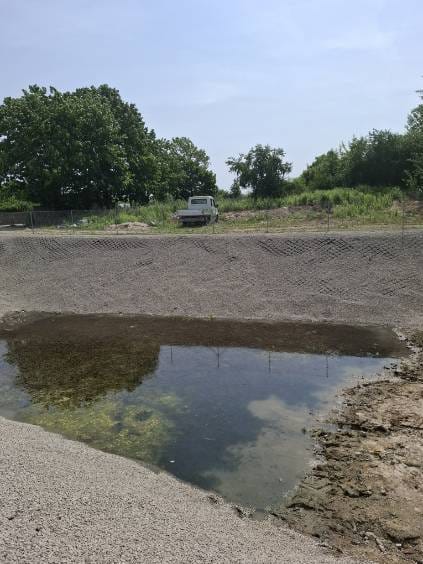
The reconstruction of an infiltration basin in Szczecin has shown how quickly weather conditions can Verify the technical solutions used.
Intense rainfall has led to the landslide of slopes with a very steep 1:1 slope, which required urgent intervention and the design of a stabilization system to withstand further water loads.
Our goal was to develop a solution that:
- Will effectively protect the slopes from further landslides,
- Will perform well on very steep gradients,
- will ensure proper filtration and drainage of rainwater,
- will be a reasonable compromise between sustainability and cost of implementation.
Check out how we approached this challenge in the Geo Globe Poland!
Who was the customer?
The general contractor of the investment was the company STRABAG, carrying out the reconstruction of an infiltration basin in Szczecin. The company was responsible for the installation of the stabilization system WATER-PLAST, with experience in hydro projects and earthworks in demanding terrain conditions.
The reservoir was located in an area subject to intense rainfall, and its geometry dictated a very steep slope, which significantly limited the possibility of using standard reinforcement solutions.
What problem did the customer face?
The original solution used did not guarantee sufficient slope stability. As a result of downpours:
- The backfill material began to move,
- Local landslides have appeared on the surface of the slopes,
- The risk of further degradation of the reservoir structure has increased.
In addition, a key challenge was the 1:1 slope of the slopes:
- significantly increases sliding forces,
- requires very effective anchoring of the system,
- limits the possibility of using larger geo-grid cells.
In addition, the filtration of rainwater had to be taken into account and the leaching of fine soil fractions had to be prevented.
Solution designed by Geo Globe Poland
In order to effectively stabilize the slopes of a 1:1 slope reservoir, it was crucial not only to select the right materials, but also to develop a compromise between the durability of the solution and its cost. The goal was to design a system that would provide long-term slope stability while remaining economically viable for the investor.
Check out how we approached this challenge in 5 steps!
STEP 1: Slope profiling
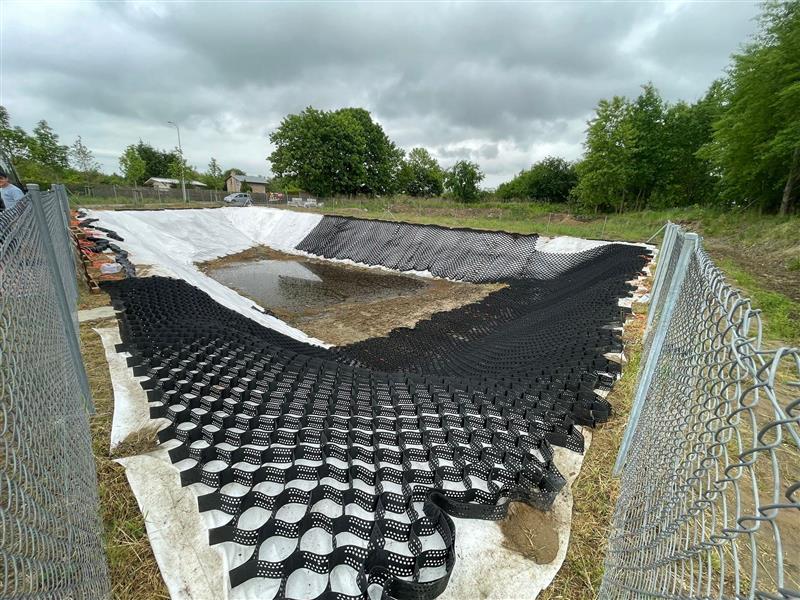
In the first stage, the slopes were properly profiled. This made it possible to obtain a stable base for the subsequent layers of the system and thus ensure proper placement of reinforcing materials.
STEP 2: Application of the separation and filtration layer
With such a steep slope, it was crucial to control two phenomena simultaneously: soil migration and rainwater flow. Without an adequate intermediate layer, even the best-anchored geogrid would not do its job.
That's why we used a separation and filtration geotextile that:
- separated the native soil from the geogrid backfill material, eliminating the risk of their mixing,
- allowed rainwater to flow freely, while retaining fine soil fractions and limiting their leaching.
As a result, the backfill layer works stably and water can be drained without undermining the slope structure.
STEP 3: Selecting the appropriate GEOMAXX® cellular geogrid.
When stabilizing the slopes of a reservoir with a 1:1 slope, it was crucial to select a geo-grid geometry that would effectively limit the movement of backfill material while remaining a cost-effective solution.
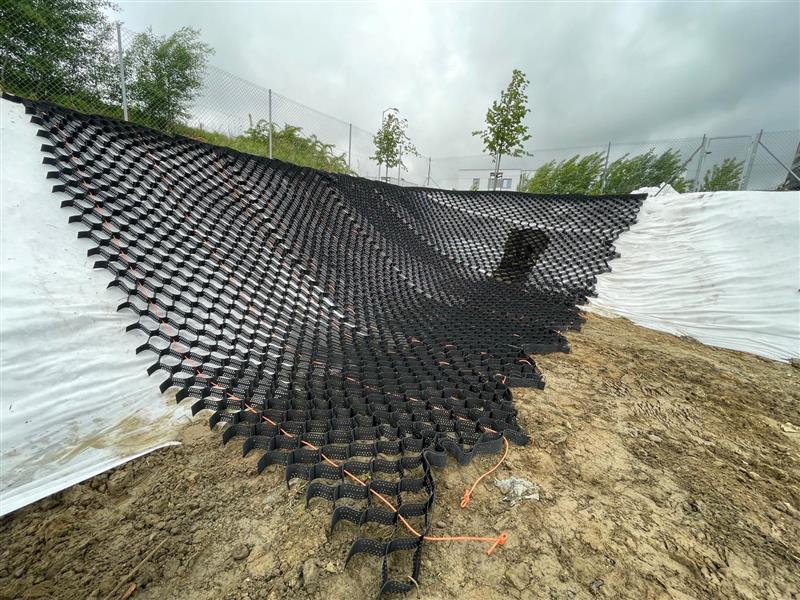
That's why we recommended the use of cellular geonets GEOMAXX® With as small a cell size as possible: 250 × 260 mm and 10 cm high, customarily referred to by us as „small cells.” This arrangement was a compromise between the price implied by the smallest cell size and the effectiveness of stabilization at the very steep slope of the reservoir slopes.
STEP 4: Making a dense anchoring system
Anchoring determines whether the entire stabilization system will work as a cohesive structure, so it was crucial to design a dense and precisely placed anchoring system to match the geometry of the slopes and the loads acting on the structure.
The solution used included:
- anchoring each mesh of the geo-grid on the crown of the slope, which prevented the system from slipping from the top,
- On the surface of the slopes, the use of an average of about 3 anchors per 1 sq. m. ensured that forces were transferred evenly to the ground.
STEP 5: Stiffen the structure with a tension system
The final step was to stiffen the entire stabilization system. For this purpose, a tension cable was used, acting as an integrating element.
The end result - what did the customer gain?
Solution used:
- It effectively eliminated the problem of landslides after heavy rainfall.
- It ensured proper filtration and controlled drainage of rainwater.
- It allowed an optimal compromise between the required effectiveness of stabilization and the cost of implementation.
Proper execution of the system by WATER-PLAST, according to the developed technical guidelines, gives full assurance of durability and trouble-free operation of the tank in the long term.
Gallery:
Do you have any questions? Contact the Geo-Globe experts!
Follow us on social media
You may also be interested in:
- Geo Globe Polska at the Plastenica Expo 2026 trade fair
 On November 3-5, 2026, Geo Globe Polska will participate in the premiere edition of Plastenica Expo at Ptak Warsaw Expo in Nadarzyn. At a joint stand, we will present vacuum thermoforming and the GEOMAXX® cellular geosynthetic. We invite you to Hall C, stand C34. The premiere edition of the trade fair for the plastics industry, International Polymer and Technology Trade Fair for Plastics Processing ...
Geo Globe Polska at the Plastenica Expo 2026 trade fair Read More "
- Plate thickness vs. thickness of the finished part: what to consider when designing thermoforming?
 The thickness of the thermoforming plate is not the thickness of the wall of the finished component. During molding, the heated material stretches, and its thickness changes locally. Therefore, the selection of material should take into account the geometry of the part, the minimum requirements in critical areas, and the conditions of use. The „ABS plate” information with the specified dimension is not enough to assess the strength of the enclosure, the guard, or the transport rack. This …
- How to choose a cellular geocoin? Price, durability and technical parameters
 Does a lower price actually mean savings? Cell geogrids currently available on the Polish market at first glance look almost identical. They have a similar design, similar dimensions and are offered for the same applications: for making driveways, parking areas or access roads, for reinforcing slopes or stabilizing the ground. However, the price difference can be significant. In such a situation, naturally the question arises …
How to choose a cellular geocoin? Price, durability and technical parameters Read More "
- Case Study – Business class tables with a functional permanent print – an individual solution for the aviation industryHow did we implement new technology to meet the high demands of the aviation industry? In the aviation industry, there is no room for chance. Especially when a component reaches the business class cabin, where technical precision must go hand in hand with the aesthetics of the premium class. For one of our clients, we developed thermoformed table components. They had to work precisely with the entire mechanism and meet the required …






 English
 Polish
 German