


Automobile manufacturers and parts suppliers must meet strict quality standards that regulate not only the parameters of the finished product but also the design, production, and quality control processes. However, meeting quality standards is only the starting point. In practice, automotive companies are looking for solutions that not only allow them to achieve the required quality but also streamline the production process, reduce the risk of errors, and optimize costs throughout the product lifecycle. It is at this stage of the design that decisions are made that affect the repeatability of production, process stability, ease of assembly, and the reduction of the risk of complaints and quality issues in subsequent stages of the project.
In this article you will learn:
- What quality standards apply to manufacturers of plastic automotive components?
- What should be considered when choosing a manufacturer of plastic components?
- How can we reduce the risk of complaints and quality issues already at the design stage?
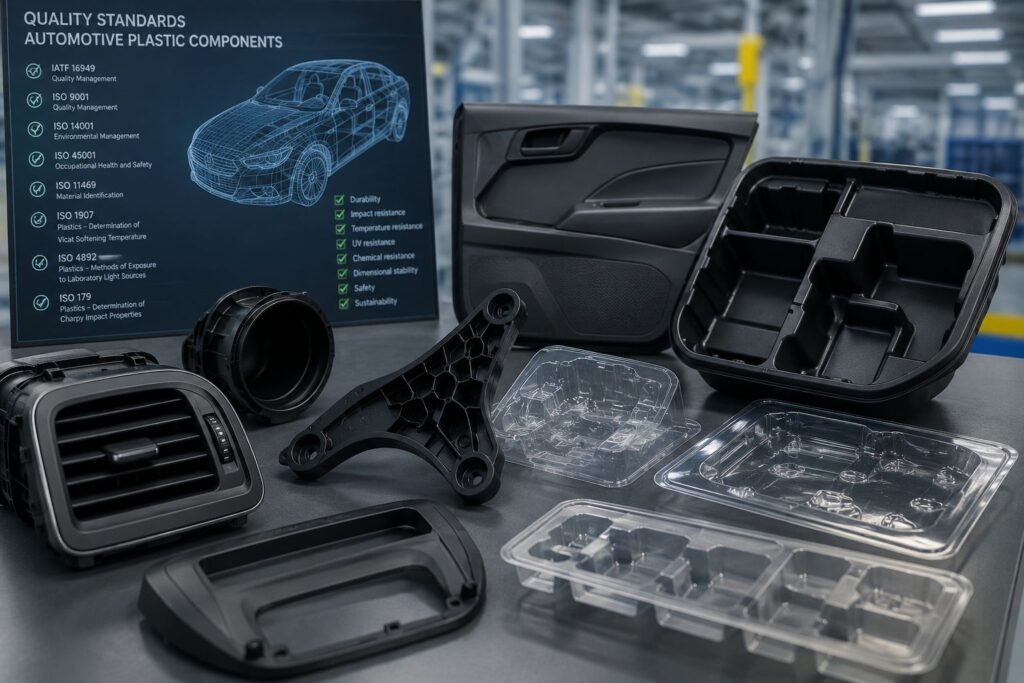
What quality standards apply to manufacturers of plastic automotive components?
Automotive industry It places high demands on manufacturers of plastic components. Quality of the finished product is not only important, but also its repeatability, durability and compliance with technical requirements at every stage of production. The standards applicable in the automotive industry cover three main areas: quality management, process control of production, and verification of material properties. Let's take a look at the most important ones.
Quality management standards – how to ensure repeatability of production?
The automotive industry relies on quality management systems that help reduce the risk of errors, monitor production processes, and ensure that components meet technical requirements.
IATF 16949 – Quality foundation in the automotive industry
One of the most important standards in the automotive industry is IATF 16949. This is a quality management system standard that was developed specifically for the automotive sector. In practice, this means that quality is not evaluated solely based on the finished component. Equally important is the, how it was designed, from what material it was made, how its production took place and whether the manufacturer is able to document the entire production process.
For manufacturers of plastic components IATF 16949 standard relates, among other things, to:
- the identification of materials and production batches,
- constant monitoring of the parameters of the production process,
- risk analysis already at the component design stage,
- the implementation of measures to prevent the occurrence of defects,
- documentation of quality control and measurement results.
For many automotive manufacturers and Tier 1 suppliers, IATF 16949 certification is one of the essential conditions for supplier qualification. It confirms that the manufacturer operates based on processes that meet the automotive industry’s requirements in terms of quality, traceability, risk management, and continuous improvement.
ISO 9001 – the foundation of orderly processes
ISO 9001 is the most popular quality management standard in the world. For customers, this means greater certainty that the manufacturer operates according to clearly defined rules and is able to maintain a stable level of quality regardless of the size of the order.
Production standards – how to control the accuracy of component assembly?
Even the best material and the most advanced quality system will not guarantee the desired result if the component is not manufactured in accordance with the design requirements. In the automotive industry, standards regulating the accuracy of the manufacture of plastic parts are of great importance.
ISO 20457 and DIN ISO 20457 – guarantee of accuracy and repeatability of execution
ISO 20457 specifies the requirements for the design, production, and acceptance of molds used to manufacture plastic components. Its European equivalent is DIN ISO 20457.
Material standards – how are the properties of plastics verified?
To verify that the material meets the requirements of the automotive industry, a series of tests are carried out regarding its mechanical, thermal, and processing properties. The most commonly used standards are presented in the table below:
| Norma | What does it study? | Importance in automotive |
| ISO 527 | Resistance to stretching | Determines the material's resistance to mechanical loads |
| ISO 178 | Resistance to bending | It allows to assess the stiffness of the component |
| ISO 1133 | The flow index of the plastic (MFR/MVR) | It helps determine the material's behavior during processing |
| ISO 306 | Vicata softening temperature | It verifies the material's resistance to elevated temperatures |
| ISO 6721 | Dynamic properties of plastics | Determines the behavior of the material under the influence of vibrations and cyclic loads |
In practice, compliance with material standards serves as the starting point for selecting the appropriate material. The final decision should take into account not only the required technical parameters but also the component's intended use, working conditions, and the specific characteristics of the production process.
Why compliance with standards is just the beginning?
In the automotive industry, compliance with standards is the norm. Competitive advantage is built through the appropriate selection of materials, optimization of designs, and the choice of technologies that allow optimizing production and reducing the risk of quality issues. In practice, automotive manufacturers are increasingly seeking partners who, in addition to production itself, also offer design and technological support. The ability to consult on material selection, prototype fabrication, design optimization, and adapting technologies to the requirements of serial production allows reducing the risk of costly changes at later stages of the design process.






 English
 Polish
 German