


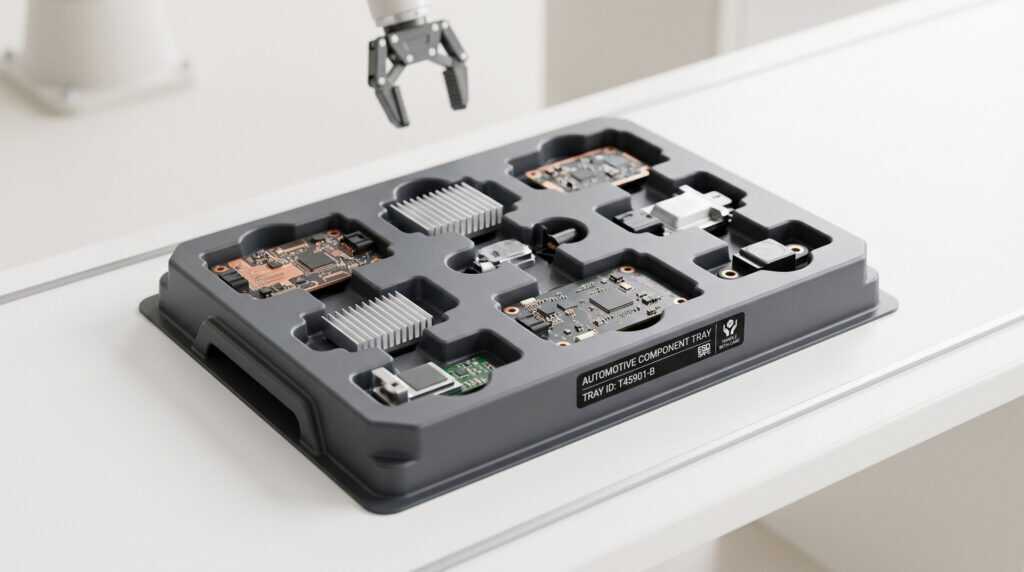
Automotive transport trolleys These dedicated carrier systems are designed for specific automotive components – from ADAS sensors to upholstery elements – that protect parts from damage and ensure precise positioning at every stage of the supply chain, from a Tier 2 supplier to the assembly station at the OEM plant.
Imagine a production line at an OEM facility where another batch of components arrives at the station every few dozen seconds. Engine covers, ADAS sensors, upholstery elements, injectors – each of them costs much more than the cardboard box in which it arrives. And each of them can be damaged, scratched, or incorrectly positioned if the transport carrier was not designed with sufficient precision. The consequences? Complaints, downtime, costs that no one had planned for.
Automotive transport pallets are the engineering solutions to this challenge. They are not conventional packaging – they are dedicated support systems designed for a specific component, a specific process, and specific supply chain requirements. Their role begins at the production line of a Tier 2 supplier and only ends when the component reaches the assembly station at the final plant.
In this article, we explain what automotive transport pallets are exactly, what types and materials are used in practice, how their design and production are carried out, and what to consider when choosing a supplier. This is a read for those responsible for quality, logistics, and purchasing in the automotive industry – those who know that the details in the packaging can decide the fluidity of the entire supply chain.
More than just packaging – the role of transport trays in the automotive supply chain
Automotive transport tray It is a dedicated, shaped carrier for components designed to meet the specific shape, weight, and production requirements of a given part. This is the key distinction: we are not talking about general-purpose packaging that can be adapted to various products. We are talking about an engineering solution designed from the ground up for a single, strictly defined application.
In the automotive supply chain, components undergo many stages before reaching the assembly line. A Tier 2 supplier produces the component and packs it into a tray. It then goes to a Tier 1 supplier, who can perform further processing or assembly of the component; only then does the component travel to the OEM facility. At each of these stages, the protection requirements can be different – there are different mechanical exposures, different transport conditions, and different positioning requirements during unloading.
That is exactly why selection such as transport It is not a secondary decision. It is a decision that directly affects the quality of the component when it is used. A component that arrives with a scratch, deformation, or damaged paint surface is not suitable for assembly. Any such situation generates costs: a complaint, additional transport, analysis of the causes, and potential downtime of the line.
Positioning errors are a separate category of risk. If the jig does not hold the component in a precisely defined position, the operator on the assembly line loses time in manual alignment or, worse still, assembles the component without verifying its setup. In a production environment where every second counts, such situations are unacceptable.
The real costs of poor packaging design go far beyond the price of the damaged component. They include the analysis of complaints, the costs of return logistics, line downtime, and potential contractual penalties. In the automotive industry, where quality requirements are among the most stringent in the industry, a supplier that does not control the quality of packaging quickly loses credibility with its OEM partners.
A well-designed transport tray eliminates these risks. A precise slot holds the component in a specific position regardless of the transport conditions. The appropriate material and wall thickness absorb vibrations and impacts. A thoughtful stacking system allows for efficient use of storage space without the risk of overloading the lower layers. All of this together creates a system that protects the value of the component at every stage of its journey to the assembly line.
Types of trays and their applications in automotive production
There is no one universal type of transport solution for the automotive industry. The choice of the right solution depends on the characteristics of the component, the intensity of the material flow, the logistical requirements, and the packaging strategy of the entire supply chain.
The first fundamental distinction concerns the one-time or repeated use of packaging. One-time packaging is designed for a single transport cycle – after reaching the destination, it is discarded or recycled. It is suitable for long-distance export shipments, for components with irregular shapes that are difficult to standardize, or when the return logistics of packaging is economically unjustified.
Recyclable trays, also known as returnable trays, operate in a closed loop between the supplier and the OEM facility. After the components are unloaded, the empty trays return to the point of origin and are refilled. They require a more robust design and higher resistance to repeated use, but in the long term they prove to be significantly more economical and environmentally friendly. Recyclable systems are widely used in the European automotive industry, often based on KLT (Kleinladungsträger) standards developed by the VDA, the Verband der Automobilindustrie.
The second key distinction is between dedicated (custom-made) versus blister trays. Standard sockets offer specific dimensions and socket configurations that can fit many different components with similar dimensions. They are more readily available and cheaper in the short term, but rarely provide optimal fit for a specific component.
Tace dedicated products are designed and manufactured for a specific component. The investment in the production form is higher at the beginning, but the result is unequivocal: perfect geometric fit, precise positioning, and maximum protection. When is this investment worthwhile? When the component is expensive and sensitive to damage, when production is serial and long-term, when OEM requirements precisely dictate how the parts are delivered to the assembly line.
Typical examples of components requiring dedicated trays are bumpers and engine covers, where protection of the painted surface is crucial; upholstery elements with delicate finishes; injectors and other precision mechanical components; and increasingly widely used ADAS system components such as cameras and radar sensors.
This last category deserves a separate discussion. The optical and electronic components used in modern vehicle safety systems require plates that meet additional requirements. First and foremost, anti-static protection: electrostatic discharges can damage electronics in a way that is invisible to the naked eye, becoming apparent only during vehicle operation. ESD Tace Electronic components are often made of materials with controlled resistivity or equipped with special conductive inserts.
Anti-vibration protection for optical components is equally important. Camera lenses, sensor arrays – each of these components can lose their calibration due to vibrations during transport. A properly designed socket with appropriate contact zones and appropriate cushioning material eliminates this risk.
Materials and production technology – why thermoforming dominates in automotive
The choice of material for the production of a transport pallet is a technical decision that directly affects the functional properties of the finished product. In the automotive industry, several basic thermoplastic materials are used, each with its own specific characteristics.
ABS (acrylonitrile-butadiene-styrene) It is one of the most commonly chosen materials for dedicated trays. It features good impact resistance, dimensional stability, and relatively easy processing during thermoforming. ABS performs well over a wide range of operating temperatures, making it suitable for production and warehouse environments.
HIPS (High Impact Polystyrene) It is an economical material valued for its good forming ability and predictable mechanical properties. It is used in both disposable trays and circulating systems with lower operating intensity. Its lower cost compared to ABS makes it suitable for applications where budget is limited and technical requirements are not extreme.
PP (Polypropylene) It stands out primarily for its chemical resistance and low weight. It is a recyclable material, which makes it increasingly attractive in the context of growing ESG requirements in supply chains. PP performs well in circulating trays that may be exposed to contact with various substances in the production environment.
PET-G This material is chosen when transparency is required – for example, when the operator needs to visually verify the presence and condition of a component without removing it from the fixture. Good mechanical strength and an aesthetic appearance make PET-G suitable for components requiring special visual inspection.
The technology dominant in the production of transport trays for the automotive industry is vacuum thermoforming. Why this method, and not injection molding, for example?
The answer lies in economics and flexibility. The costs of tooling in thermoforming They are significantly lower than for injection molds, which is particularly important for large-sized trays or those produced in medium-sized batches. Tooling lead times are shorter, which allows for faster implementation of a new product or modification of an existing design when changing the geometry of a component. Thermoforming also allows for the production of large-sized components – trunk covers, bumpers, large upholstery panels – which would be difficult or uneconomical to produce using the injection molding method.
For flow trays designed for intensive use, the twin-sheet thermoforming technology is particularly valuable. In this method, two sheets of plastic are simultaneously formed and joined together, creating a closed, two-layer structure. The result is a tray with significantly higher rigidity and resistance to deformation than in the case of single-sheet forming, while maintaining relatively low weight.
Tace twin-sheet are ideal for milk-run systems where packages circulate at an intensive pace between multiple points in the supply chain, and for KLT systems where standardization and durability are key requirements. The two-layer design also provides better thermal insulation, which can be important for components sensitive to temperature changes during transport.
Design of such a transport – from the technical drawing to the prototype
Designing automotive transport equipment is an engineering process that begins long before the thermoforming machine is launched into operation. The quality of this process determines whether the finished product meets customer expectations under real production conditions.
The starting point is a detailed analysis of the component’s geometry. The R&D department receives a 3D model or technical documentation of the part that the pallet is to transport. Based on this, support points are defined – the places where the pallet will contact the component – and contact zones that must be designed so as not to cause stresses, scratches, or deformations. For painted or delicately finished surface elements, this analysis is particularly critical.
The next step is simulation of loading and unloading. How will the operator insert the component into the fixture? How will he remove it? Is this a manual operation or an automated one using a robot? The answers to these questions directly influence the design of the fixture, the deburring angles, and the ergonomics of the entire solution. CAD/CAM tools allow for verification of these assumptions even at the design stage, before any physical prototype is made.
The key technical parameters that must be precisely specified in the design documentation include several elements. The mounting groove, the space between the component and the socket wall, must be sufficient to allow for free insertion and removal, but not so large that the component can move during transport. The depth of the socket determines the stability of the component and how much of its surface is protected. The chamfer angles are crucial both for the tacing process and for the ease of removal of the component by the operator.
The stacking system, or the arrangement of loaded trays in rows, is a separate design area. The trays must be designed so that when stacked one on top of the other, they do not transfer the load directly to the components. At the same time, the system of nesting empty trays – their compact arrangement after unloading – has a direct impact on the economics of reverse logistics. Empty trays that can be nested one inside the other take up a fraction of the space occupied by the loaded items, which significantly reduces the costs of the return transport.
After the design phase and the completion of the first prototype, the validation phase begins. The prototype is sent to the customer’s production line, where it is tested under real operating conditions. The operator’s ergonomics, the accuracy of component positioning, and the stability of the robot during transport and stacking are evaluated. If the line is automated, the operator’s interaction with robotic systems is also verified.
Validation also includes verification of compliance with OEM requirements. European car manufacturers often refer to VDA standards in the area of packaging and logistics. In the North American market, AIAG standards play a similar role. A tray supplier that knows these requirements and can document their compliance significantly simplifies the qualification process in the eyes of the OEM customer. More about how quality standards for automotive components They affect the reliability of parts, as can be read in a separate study.
Ecology and closed-loop economy in automotive tray systems
The automotive industry is undergoing a profound transformation in the area of sustainable development. OEM manufacturers are increasingly expanding their environmental goals beyond their own production facilities, including ESG requirements in qualification criteria and supplier evaluation. In this context, transport pallets are no longer purely a logistical issue – they are becoming an element of the environmental strategy of the entire supply chain.
Recyclable trays are a natural tool for a zero-waste strategy in component logistics. Instead of generating a stream of packaging waste after each delivery cycle, they operate in a closed loop for many years. Compared to disposable cardboard or foam solutions, multiple uses translate into a significant reduction in packaging material consumption per delivered component. The longer the tray remains in circulation and the more cycles it completes, the more favorable its environmental footprint becomes.
Another environmental measure is the possibility of using recycled materials in the production of trays. In the cradle-to-cradle approach that Geo Globe Polska applies in its production practice, recycled regranulate can be used as the core material of the tray, while the outer layer retains the full surface quality and mechanical properties required by the customer. This solution allows for a real reduction in the use of virgin plastics without compromising on quality.
At the end of the life cycle of plastic crates made from thermoplastics such as PP or ABS, they can be recycled as material. Closed loop: production with recycled material, long-term use, recycling after decommissioning – this is the practical implementation of the principles. closed-loop economies in the field of industrial packaging.
Environmental certificates play an increasingly important role in the qualification processes of suppliers. ISO 14001:2015 confirms that the supplier has an implemented environmental management system and actively monitors and reduces its impact on the environment. The EcoVadis platform, on which OEMs increasingly require the presence of their suppliers, assesses the company’s sustainable development in four areas: environment, labor rights, ethics, and sustainable procurement.
The supplier of the trays ISO 14001 certificate And the EcoVadis positive assessment not only meets the formal requirements – it provides the OEM customer with a verifiable proof that its supply chain operates in accordance with its declared environmental goals. In an environment where ESG reports are subject to increasingly strict verification, such transparency has real business value.
How to choose a conveyor belt supplier – criteria for the purchasing decision
Choosing a transport tray supplier for the automotive industry is a strategic decision, not just a purchasing one. A tray that fails on a customer’s production line generates costs that are many times greater than the savings obtained at the tender stage. Therefore, the selection criteria should focus on technical competencies, process reliability, and the ability to establish a long-term partnership.
Our own R&D infrastructure and comprehensive service: A supplier that designs, prototypes, and mass-produces trays in one place offers the customer more than just a product – it offers control over the entire process. Every transfer between the external design office, the tooling department, and the manufacturer creates a point of potential communication errors and delays. Integrating these competencies within a single organization reduces implementation time and minimizes the risk of discrepancies between the project and the finished product.
Quality certification and knowledge of sectoral requirements: ISO 9001:2015 is the basic certificate for a quality management system that confirms that the supplier’s processes are documented, monitored and improved. In the context of the automotive industry, a practical knowledge of the requirements of OEMs is equally important: VDA standards, packaging standards used by specific vehicle manufacturers, documentation and validation requirements. A supplier with references in the automotive, railway and medical sectors – sectors with similar levels of quality requirements – gives the customer justified confidence that they understand the specifics of environments with high standards. It is worth checking how custom tray for transporting engines it can simultaneously reduce material consumption and meet the strict industry requirements.
Flexibility and scalability of production: The automotive industry is characterized by dynamic changes: new vehicle models, modifications of components, changes in geometry resulting from design updates. The tray supplier must be able to respond quickly to such changes – modify the shape, adapt the socket design, and start production of the modified tray without lengthy downtime. Equally important is the ability to handle both small pilot series and large volumes of serial production.
It is also worth paying attention to the provider’s approach to after-sales service and technical support. Flow packagers require monitoring of their technical condition during operation. A provider that offers support in assessing wear and tear, repairs, and planned replacement of the packagers becomes a partner in managing the packaging system, rather than just a one-time contractor of the assignment.
An investment in process quality, not in packaging costs
The automotive transport tray is much more than just a position in the logistics budget. It is an element of the quality system that protects the value of the component at every stage of its journey to the assembly line. A well-designed tray eliminates the risk of damage, ensures precise positioning, and supports the fluidity of the production process. A poorly designed one generates costs that are difficult to predict at the purchase stage and are easily felt in the form of complaints, downtime, and tensions in relationships with the OEM partner.
Choosing such a supplier means choosing a provider who understands this relationship. One who can translate the component’s geometry into a precise socket design, choose the appropriate material for the operational requirements and conduct validation in real production conditions. One who holds ISO 9001:2015 and ISO 14001:2015 certifications, because quality and environmental responsibility are not mere marketing slogans for them, but documented work standards.
Geo Globe Polska offers a comprehensive service for transport trays for the automotive and related industrial sectors: from design and prototyping, through validation, to serial production. Our own R&D laboratory, over 30 years of experience in thermoforming plastics and a cradle-to-cradle approach to product design make us a partner ready to work on both pilot projects and demanding long-term implementations.
If you are looking for a supplier of transport containers that combines technical expertise with environmental responsibility and knowledge of automotive supply chain requirements, we invite you to talk. Check out Geoglobe find out what we can do and contact our team to discuss the requirements of your project and receive a quote or technical consultation.


 English