


Does a lower price really mean savings?
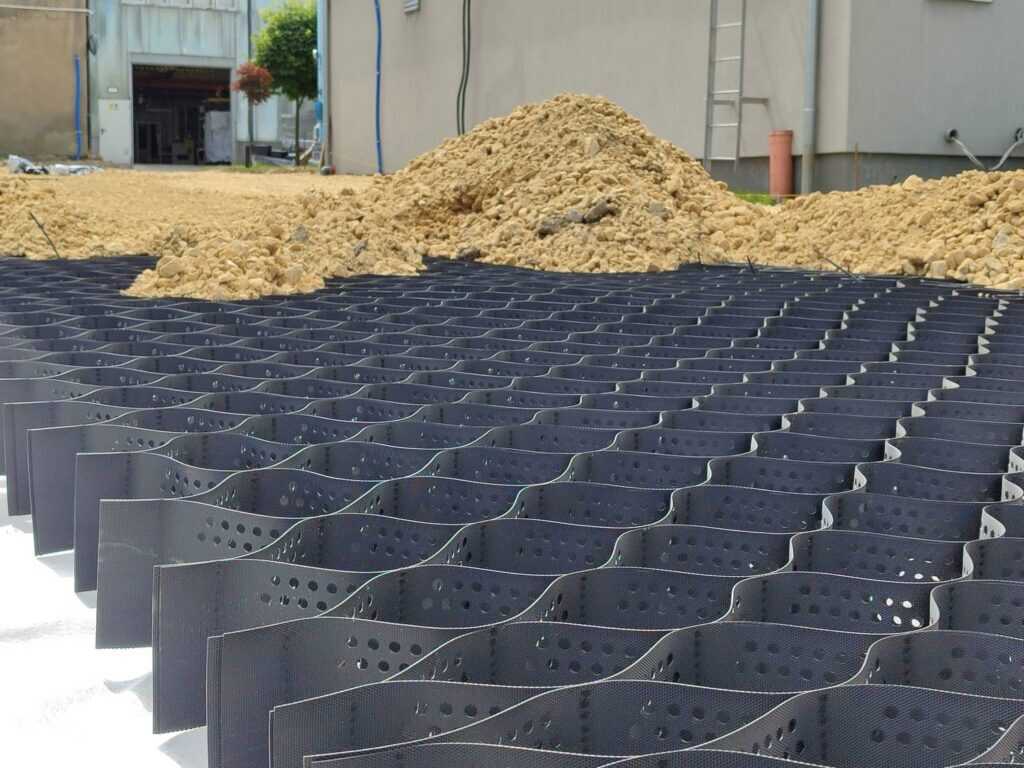
Cellular geogrids currently available on the Polish market at first glance look almost identical. They have a similar design, similar dimensions and are offered for the same applications: for driveway construction, parking or access road construction, for retaining walls or ground stabilization. However, the price difference can be significant. In such a situation, the question naturally arises: Why pay more when the product looks similar and, according to the seller, has comparable parameters?
The problem lies in the fact that the quality of a cellular geosynthetic membrane cannot be assessed solely by its appearance or even the description provided in the offer. The durability of the manufactured structure is determined primarily by the material’s mechanical properties, the quality of workmanship, and the compliance of the declared parameters with the test results. This is particularly important in the case of products of unknown origin and geosynthetics imported from outside the European Union, including from China. The country of manufacture itself does not yet determine the quality of the material. The risk arises when the product’s origin is difficult to determine, the documentation is incomplete, and the declared properties are not confirmed by reliable testing.
To verify how the information presented by the manufacturer translates into the actual durability of the material, we at Geo Globe Polska conducted an analysis of one of the cellular geostrips available on the Polish market in our laboratory. The results showed a significant difference between the declared product class and its actual properties. What exactly was revealed by the analysis and what should be taken into account before purchasing a cellular geostripe?
In this article you will learn:
- which parameters of the cellular geostationary satellite to pay attention to before purchasing,
- whether the data presented in the technical sheet are always confirmed by the studies,
- how to verify the manufacturer or importer of the geosynthetic material,
- does the cheaper cellular geostationary satellite really save money.
The price of a cellular SIM card – what do you really pay for?
Attractive price cellular geonets It can be tempting, especially when the material is to be used on a large surface area. However, a comparison of the price per square meter alone does not provide an answer as to whether the products being combined provide similar quality and durability. The height of the cells, the dimensions of the sections, and the declared application can be relatively easily checked in the product description. It is much more difficult to assess the actual mechanical properties of the material, the durability of the connections, and the repeatability of the parameters of subsequent batches.
The price of a cellular geostationary satellite depends on factors such as:
- the quality and properties of the raw material used,
- strength of the material and the connections between the cells,
- the repeatability of the production process,
- the scope of the quality control carried out,
- studies confirming the declared parameters,
- completeness of the technical documentation,
- access to the manufacturer's support.
Two geosatellites can have similar dimensions and be offered for the same applications, yet they will behave completely differently under load. It is this difference that we decided to verify in the Geo Globe Polska laboratory. We subjected the product available for sale on the Polish market to the test. According to the manufacturer’s claims, it was supposed to offer properties comparable to a cellular geosatellite. GeoMaxx® – a solution produced and developed in Poland for over 20 years. Have the results confirmed the declared product class?

The durability of the cellular geostatistical grid – what did the research show?
According to the manufacturer’s information, the geosynthetic examined had mechanical properties comparable to those of the stronger GeoMaxx® solutions used in structures subjected to greater loads. The results obtained in the laboratory did not confirm these assurances.
The material’s strength was approximately 20% lower even when compared to the basic version of GeoMaxx®, designed for simpler applications and work with lower loads. This means that the geosynthetic offered as a high-strength solution did not even meet the parameters of the variant designed for less demanding applications.
The study concerned a specific product available on the Polish market. Therefore, the result should not be applied to all geosynthetics imported or to all materials originating from a specific country. However, it shows that the values presented in the documentation or in the offer description do not always correspond to the actual properties of the material.
What does too low geosynthetic strength mean in practice?
The primary function of a cellular geonet is to maintain the filling material inside the cells, stabilize the ground, and support the proper transfer of loads. For the structure to function as intended, the geonet must maintain properties appropriate to the type of surface and the intended method of use. If the material’s actual strength is lower than stated, the geonet may not provide the expected level of stabilization. Initially, the difference may remain invisible because the product is under a layer of gravel or soil. Problems may only become apparent after some time, with further loads and use of the surface.
Using too high a quality of geosynthetic material can increase the risk:
- the movement of gravel or other filling material,
- gradual loss of ground stability,
- the formation of hills, depressions and unevenness,
- deformation of the surface under the influence of regular loads,
- excessive or uneven settlement of the ground,
- shortening the expected durability of the structure,
- the necessity of more frequent resurfacing and leveling of the surface,
- carrying out expensive repairs,
- re-execution of part of the works.
The extent of the consequences depends, among other things, on the type of substrate, the quality of the workmanship, the filling used, and the actual loads. The driveway to the house will work differently than a parking lot, driveway, or embankment. In each of these cases, however, using a material with parameters lower than those specified increases the risk that the structure will not maintain the expected durability.
Does cheaper cellular geosatellite really save money?
Unfortunately, the effects of using geosynthetic material of insufficient strength may not appear until several months or even years after the pavement has been in use. At that point, the savings obtained during the purchase stage must be weighed against the costs associated with:
- by purchasing additional gravel,
- by re-leveling the terrain,
- repairing the deformed surface,
- by removing the previously applied layers,
- by purchasing a new geosatellite,
- transporting additional materials,
- redoing the works.
Does a cheaper geosynthetic material always turn out to be a bad choice? No. A lower price can mean real savings, provided that the product actually meets the requirements of the intended use and that its parameters are confirmed in tests. However, it is worth remembering that the price alone does not yet tell us anything about the durability of the material. If the geonet does not provide the expected stabilization, subsequent repair costs could easily exceed the amount saved when purchasing it. So how can we reduce this risk?
How to choose a cellular geocache and avoid the apparent savings?
Before purchasing, it is worth checking not only the price and the product description displayed in the store, but also the documents and information that allow you to assess its actual quality. Pay attention to the following issues:
- Origin of the product
Check who is the manufacturer of the geosynthetic material, where it was produced, and who is responsible for its sale or import. Material of unknown origin can be more difficult to verify, especially if questions arise regarding its parameters or the quality of workmanship.
- Product purpose
Make sure that the selected geosynthetic material is suitable for the intended use. Other properties may require a garden surface, a driveway for the house, and another parking area, access road, or a structure subjected to regular loads. It should not be assumed that any geosynthetic material with similar cell height can be used in the same way.
- Technical documentation
The documentation should clearly specify the properties of the material, its intended use, and the conditions of use. The description itself included in the sales offer does not yet guarantee that the product has been properly tested. Pay attention to whether the information provided is specific, consistent, and verifiable.
- Results of the research
Check whether the parameters declared by the manufacturer are confirmed by tests. It is also worth determining whether the manufacturer or seller is able to provide documents confirming the durability of the product. The values themselves entered in the technical data sheet are not always sufficient to assess the actual quality of the material.
- Experience of the manufacturer or importer
What matters is not only the number of years of presence on the market, but also the control of the production process, the repeatability of quality, and the ability to obtain information about the product being offered. Experience does not replace documentation or test results, but it can increase the confidence that the manufacturer knows the properties of their materials and is able to tailor them to a specific application.
- Access to technical support
A reliable manufacturer should not limit itself to selling geosynthetic material only. Technical support allows choosing the right product variant based on the type of soil, expected loads, and the construction method. It is also important when questions arise regarding parameters, installation, or documentation before purchasing. Price remains an important selection criterion, but it should not be the only one. The more information can be verified before purchasing, the less risk that an attractive offer will turn out to be only an apparent saving.
Do you need help choosing the right solution or would you like to compare the parameters of available products? Contact the Geo Globe Polska team: We will help you choose the material based on the type of substrate, the expected loads, and the specific requirements of the planned implementation.


 English